|
Hello, and happy Wednesday. If you’re disappointed that “I’m Just Ken” didn’t win an Oscar, fret not: Today’s Ken Day! Either today or March 11 is the anniversary of the day Mattel introduced Ken back in 1961, depending on who you ask. (We say any day is a good day to celebrate Ryan Gosling.)   🦩 🦩
In this issue:
🫂 PDA
 VC boys club VC boys club
 ESG overconfidence ESG overconfidence
—Courtney Vien, Graison Dangor
|
|
Traffic_analyzer/Getty Images
|
Going public is an exciting moment in many companies’ journeys. It’s both a sign that a company has reached a certain level of maturity, and an opportunity for greater visibility and access to capital. But the process of going public can also help motivate and energize employees, Matt Skaruppa, CFO of Duolingo, told CFO Brew.
A goal everyone can align around: Skaruppa, who joined Duolingo in 2020 and took it public in 2021, said going public “is a unique moment in time to drive the deepest strategic alignment through from the top to the bottom of the business” because “the whole company has the chance to rally around the incredibly exciting goal.” It helps get everyone on the same page about what they’re doing, why, and what market they’re targeting, he said.
The long-term nature of the IPO goal is also salient, he said: “Nobody goes public to get public and then stop being public,” he said. “You go public because you think you’ve built a durable business that can last 100 years.”
Skaruppa and his team made the somewhat unusual choice to share news and updates about the IPO process with employees at all levels. “We would get in front of the entire company and talk about it at all-hands meetings,” he said. “[We would] tell people about our plans and what we are going to say publicly about our strategy and what it meant.”
Click here for more on how Duolingo’s IPO helped attract talent.—CV
|
|
|
FP&A is an essential business function—but it can also feel like herding cats.
Long nights spent gathering and reconciling data from multiple sources. Meetings upon meetings to get stakeholders to agree on assumptions. Decision-making blocked by tedious manual data entry and inaccuracies.
It’s enough to make anyone’s head spin. Thankfully, there’s Cube.
With Cube, you can automate data entry, fast-track insights, make decisions that guide future business performance, and keep collaborators in lockstep—all from the comfort of your spreadsheets.
If you’re ready to get out of the weeds and into the strategy, try Cube. Bonus alert: Get a $100 gift card when you hop on a quick call to talk FP&A.
|
|
Nuthawut Somsuk/Getty Images
|
Women-founded companies in the US received their largest-ever share of venture capital deals last year, according to PitchBook. Sounds great, right? There are just a few oh-so-tiny caveats.
First, overall VC funding absolutely tanked in 2023, falling from $242.2 billion raised in the US in 2022 to $170.6 billion. So while women-founded companies got 27.8% of the VC pie last year compared to 18.7% in 2022, last year’s pie was much smaller. So much smaller, in fact, that their $44.7 billion haul last year was just half a billion more than the $44.2 billion raised in 2022.
Caveat No. 2: That $44.7 billion is massively skewed by one $10 billion deal for OpenAI, whose founders and early funders include several women. Without that deal, companies founded with women would have raised $34.7 billion last year, or $9.5 billion less than in 2022.Their share of deal value without the OpenAI deal, 22.8%, is still an increase over 18.7% from 2022. But again: tinier pie.
It wasn’t just that founders of all genders raised fewer VC dollars last year. There were also a lot fewer deals. (By the way, we’re on our third caveat.) The number of deals also fell for women-founded businesses. Companies founded by women alone received 20% fewer deals last year: 894 vs. 1,112 in 2022. For companies founded not exclusively by women (i.e., dudes involved), deals in 2023 fell 25%, to 3,315.
How did women founders fare with VC? Click here to find out.—GD
|
|
Nicoelnino/Getty Images
|
When it comes to ESG readiness, companies are like the children of Lake Wobegon: They all think they’re above average. 83% of respondents think their companies are doing better than their peers when it comes to ESG, according to a KPMG survey.
Companies “think they’re ahead on sustainability reporting because they have set these ambitious goals and targets” such as achieving net zero emissions, Maura Hodge, ESG audit leader at KPMG US, told CFO Brew.
But there’s a gap between many companies’ aspirations and their abilities. “In a number of instances, they may not have done all the due diligence necessary to fully understand” concepts like how to undertake a greenhouse gas inventory, she said.
It's understandable that companies are having growing pains when it comes to ESG reporting, Hodge said, because the area’s so new and rapidly evolving. In fact, 71% of respondents said vital ESG reporting is or will be outsourced over the next three years, a fact that speaks to how complex this area is. “It was an affirmation of how new all this information is and how much education and training and need for subject matter expertise there is,” Hodge said.
For more on how prepared companies are for ESG reporting, click here.—CV
|
|
|
Here’s to better closings. This ebook by Trintech shares five best practices CFOs can use to improve accuracy in month-end closings, reduce financial risk for their org, and gain valuable time back. Help your team operate more efficiently and quickly with a copy of the ebook.
|
|
Francis Scialabba
Today’s top finance reads.
Stat: $500,000. That’s how much it costs a ship, on average, to go through the Panama Canal. Lower water levels have interfered with Panama Canal traffic in recent months, causing supply chain disruptions and higher charges.  (the Wall Street Journal) (the Wall Street Journal)
Quote: “They claim to be a leader in this so it’s really important for them to actually have that level of disclosure.”—Grace Su, portfolio manager at Clearbridge Investments, on fast fashion company Inditex, which owns Zara, after investors asked Inditex to be more transparent about its supply chain like industry peers such as H&M and Primark (Reuters)
Read: GM and other automakers are sending information about customers’ driving habits to auto insurance companies—in some cases, without their knowledge. (the New York Times)
|
|
|
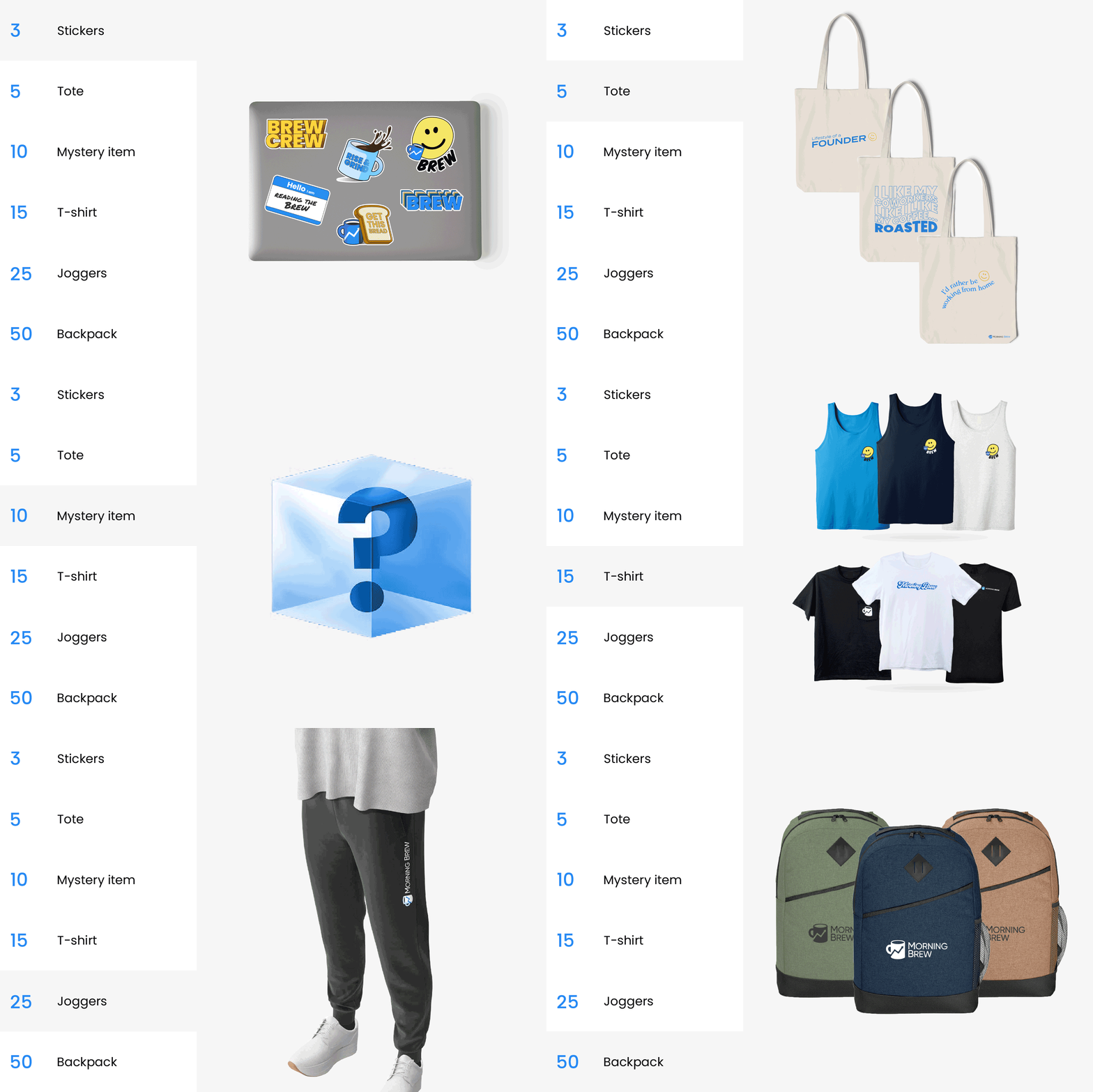
Share CFO Brew with your coworkers, acquire free Brew swag, and then make new friends as a result of your fresh Brew swag.
We’re saying we’ll give you free stuff and more friends if you share a link. One link.
Your referral count: 2
Click to ShareOr copy & paste your referral link to others:
cfobrew.com/r/?kid=9ec4d467
|
|
|