Buzzword
To:Brew Readers
CFO Brew // Morning Brew // Update
How can CFOs forecast in the era of uncertainty?

Hello, and welcome to Tuesday. First, AI came for the coders and we said nothing because we don’t code. Then AI came for the consultants and we said nothing because consultants get paid way too much money. And then AI came for…everyone else.

In this issue:

Fortune telling

Growing up

🟢 Getting started

Natasha Piñon, Courtney Vien, Jesse Klein

STRATEGY

Uncertainty CFOs strategy

Anna Kim

The band Paramore is in the business of misery, cows are in the business of mooing, ghosts are in the business of spooking.

CFOs, meanwhile, are in the uncertainty business, or more specifically, the forecasting business. And in the tumultuous times we currently live in, that’s becoming an increasingly difficult undertaking—with the consequences of getting it wrong reverberating in new ways.

“If you’re kind of close to your forecast—either above or below—you’re in fairly good shape,” Campbell Harvey, a finance professor at Duke University’s Fuqua School of Business and a founding director of the closely watched Duke-CFO survey, told CFO Brew.

However, in periods of great uncertainty, “you can make the forecast, but you have very little confidence in that forecast,” he explained. “And what that means is that there’s a high probability that what actually happens could be much different than your forecast, and that’s where the company gets into trouble.”

No one is debating that we’re in an uncertain environment. “Is there a lot of uncertainty today? Definitely,” Harvey said. And in a sense, the prevalence of uncertainty is what makes agreeing on a definition tricky; CFOs are attributing a range of outcomes to uncertainty, but potentially using the term in different ways.

What does uncertainty really mean these days?NP

Presented By AvidXChange

TECHNOLOGY

AI ROI

J Studios/Getty Images

AI adoption is reaching a new phase, Salesforce COFO Robin Washington said during a recent roundtable: one where companies are separating the wheat from the chaff.

Businesses are moving out of the “experimentation” stage and starting to “really decide what are the true value-enhancing AI opportunities that exist,” Washington said. She recommends that companies use “cross-functional teams” to determine which use cases for AI they “want to continue to experiment on, and which ones [they] want to mature and accelerate.”

During the roundtable, she and Paypal COFO Jamie Miller suggested that the next frontier is AI for revenue generation, not just improving efficiency. The examples Miller gave, though, were fairly high-level; she noted that “agentic commerce” could let consumers have an “end-to-end experience in a much different way.”

Are we all vibe coders now? Washington and Miller leaned on the theme of jobs shifting, rather than going away, due to AI. Washington mentioned that AI can complete more of the redundant and time-consuming tasks, which, she said, “unleashes the ability for us to really do our jobs.” That’s allowed Salesforce to “reallocate employees to more value-add type of activities where we see, directionally, growth is coming from,” she said. Miller said she’s seen a similar “reallocation” of employees’ tasks at PayPal.

How are Fortune 500 companies deploying AI?CV

CFOS

James Kueser CFO

James Kueser

Coworking is a recurring segment where we talk to CFOs and other leaders in the finance space about their experiences, their companies, and the larger economy. Let us know if you are—or you know—a CFO we should interview.

As energy costs soar, CFOs are looking for new, more cost-efficient energy sources. Hydrogen energy has long held the unrealized promise of scalable clean energy, but historically, producing it has been expensive and difficult.

Vema Hydrogen, an early stage hydrogen energy company, has developed a production process that reduces the cost significantly.

CFO Brew recently spoke with Vema CFO Jim Kueser about being the CFO of a small startup, rising energy prices, and producing clean energy post-IRA cuts.

There has been some recent discussion of an oncoming recession. How are you as CFO preparing for that?

We’re in a different position a little bit because we are a pre-revenue organization, so in a recession you’re worried about your cash flow and revenue streams. Obviously, we don’t have those yet. We are effectively a cost center until we’re generating revenue. So we have a little different view.

We believe that we are going to be producing a product that is not as impacted by recessionary trends. There is a need for clean fuels that we don’t think is going to go away, and notwithstanding the potential downturn of the economy, there is going to be a demand for those clean fuels, but they must be in the form of a reliable supply and at an acceptable cost…We’re not seeking the green premium. We are seeking to be competitive with alternative forms of energy.

Click here to continue reading.JK

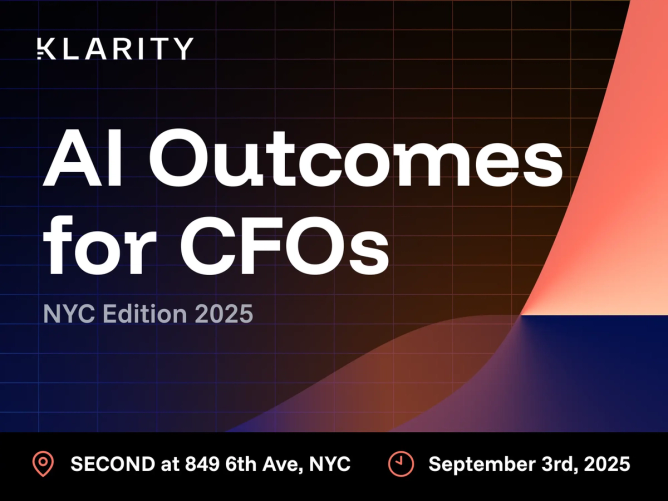
Together With Klarity

EVENTS

CFO Brew risky business event

Morning Brew Inc.

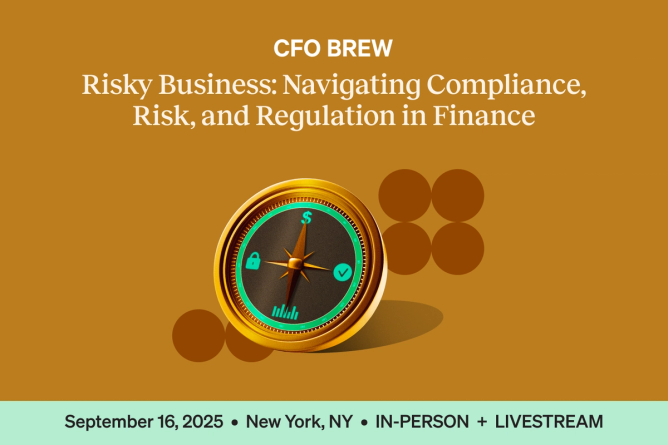
How are CFOs staying sharp in a world of mounting regulation, risk, and data pressure? Join us Sept. 16 in NYC (or virtually) for a morning of expert panels featuring leaders from Affirm, Navan, and Pagaya—plus many more—breaking down the big shifts reshaping finance. Register here.

MARKET FORCES

market forces chart

Francis Scialabba

Today’s top finance reads.

Stat: $7.7 billion. That’s how much Paramount is paying for the US rights to TKO Group’s UFC for seven years, starting in 2026. (CNBC)

Quote: “This is an own goal and will incentivize the Chinese to up their game and pressure the administration for more concessions. This is the Trump playbook applied in exactly the wrong domain. You’re selling our national security for corporate profits.”—Liza Tobin, the former China director of the National Security Council during the Trump and Biden administrations, on the unusual agreement between the Trump administration and chipmakers Nvidia and AMD, in which a portion of the companies’ sales from AI chips to China will go to the administration (New York Times)

Read: Life in the buyback economy. (Wall Street Journal)

Accounts payable upgrade: Strike the balance of human oversight and AI efficiency in your AP process. This guide from AvidXchange breaks down why and how teams are modernizing their AP with automation. Check it out.*

*A message from our sponsor.

JOBS

Skip the noise and cut to the jobs that matter. CollabWORK curates openings from top employers and shares them directly in trusted spaces like CFO Brew—click here to see the full list for readers like you.

SHARE THE BREW

Share CFO Brew with your coworkers, acquire free Brew swag, and then make new friends as a result of your fresh Brew swag.

We’re saying we’ll give you free stuff and more friends if you share a link. One link.

Your referral count: 5

Click to Share

Or copy & paste your referral link to others:
cfobrew.com/r/?kid=9ec4d467

         
ADVERTISE // CAREERS // SHOP // FAQ

Update your email preferences or unsubscribe here.
View our privacy policy here.

Copyright © 2025 Morning Brew Inc. All rights reserved.
22 W 19th St, 4th Floor, New York, NY 10011

News built for finance pros

CFO Brew helps finance pros navigate their roles with insights into risk management, compliance, and strategy through our newsletter, virtual events, and digital guides.

By subscribing, you accept our Terms & Privacy Policy.

A mobile phone scrolling a newsletter issue of CFO Brew