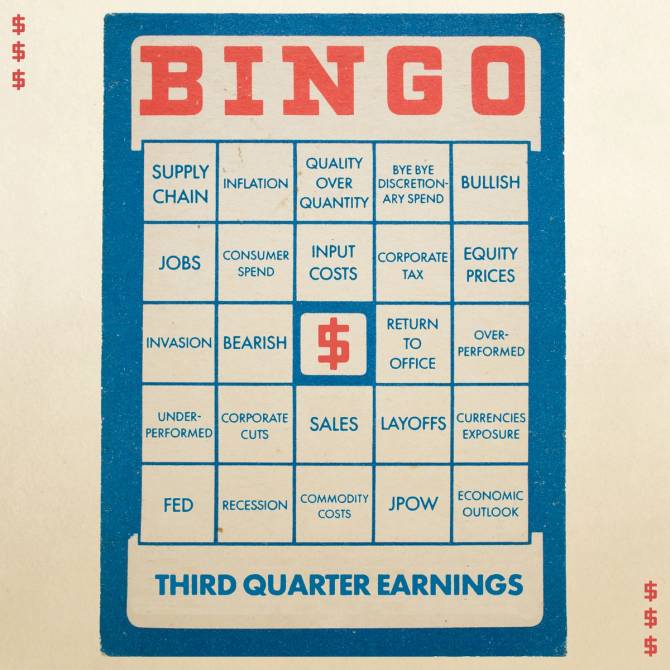
Hello, and welcome to the start of third-quarter earnings reports—we’ve made a bingo card for you to keep track of all the buzzwords you can expect to hear on earnings calls. Let us know how quickly you get five in a row; if you get bingo within one earnings call, we’ll be very impressed/depressed.
In this issue:
 ESG investor backlash ESG investor backlash
🗣 Earnings buzzword bingo
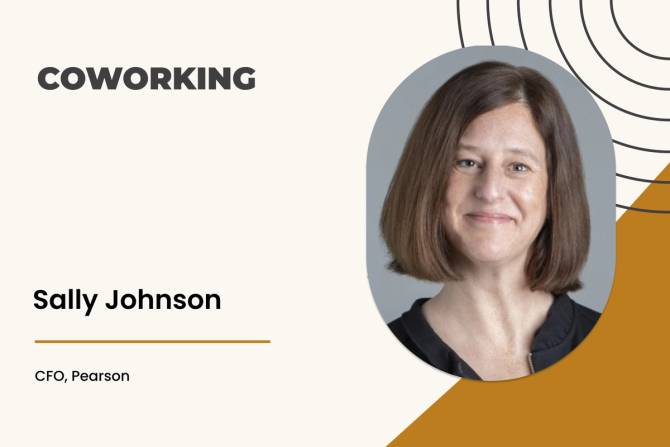
 Coworking Coworking
—Kim Lyons, Kristen Talman
|
|
Sesame/Getty Images
Investor relations departments have been on a wild ride over the past few years, as activist investors and other stakeholders have made their voices heard. Corporate finance leaders find themselves frequently under criticism from activist investors, whose demands they have to consider and whose concerns have to be addressed. And most recently, that’s meant investors pushing companies to consider their wider ecological footprints, climbing on board the ESG bandwagon.
Much of the process has been friendly: Three of every four activist campaigns begins collaboratively, according to research from consulting firm McKinsey. But that’s not to say they’re joyfully welcomed; half of those eventually turn hostile. “Each contested campaign costs a company between $10 million and $20 million—plus weeks of management time to develop plans and meet with investors,” McKinsey found.
Institutional investors have been key to pushing the ESG movement forward. In 2018, Larry Fink, BlackRock’s chairman and CEO, wrote in his annual letter that companies needed to identify their purpose, and that to “prosper over time, every company must not only deliver financial performance but also show how it makes a positive contribution to society.” Since then, BlackRock has doubled down, saying that environmental concerns would be core to its investment strategy.
And many companies have taken similar action, offering green bonds, an instrument to fund green projects; developing sustainable finance frameworks; or linking executive compensation to sustainability goals.
While corporations have, for the most part, listened to institutional investors, employees, and stakeholders, and released sustainability reports (although not without accusations of greenwashing), a new sort of activist has emerged: the anti-ESG investor. Strive Asset Management’s Vivek Ramaswamy, who is seeking to dismantle what he calls “woke capitalism,” has called into question what the future of ESG initiatives should and could look like.
“Our basic vision is that companies should focus exclusively on excellence over politics,” Ramaswamy told CFO Brew. Continue reading here.—KT
|
|
|
Let’s be real: The definitive vibe of our era is uncertainty. From a turbulent global economy to rising inflation costs, modern life has never felt more up in the air. Conducting business these days can feel like throwing a Hail Mary to nobody.
Vic.ai is here to help you tackle this new normal. Their definitive playbook for CFOs is built to help business leaders score touchdowns in the blitz that is 2022 and for years to come. Learn how to:
- Improve process efficiency and accuracy.
- Create an agile finance team structure.
- Reduce costs by utilizing technologies.
Vic.ai is changing the game. Stay ahead of the rush and download the CFO playbook today.
|
|
Dianna “Mick” McDougall, Photo: tbd/Getty Images
As we round the corner into October, it’s pumpkin spice but not-so-nice in the outlook for third-quarter earnings.
Q3 earnings calls with investors are likely to be stuffed as full as Thanksgiving turkeys (can you tell we are in an autumn mood?), with inflation woes, supply-chain concerns, and all-but-certain fretting about a possible recession.
Some companies, such as Nike and Bed Bath & Beyond, have already stepped up to the carousel, reporting earnings on September 29. The big banks, often bellwethers of the macroenvironment given their connections to much of the economy, will report in mid-October, with JPMorgan, Morgan Stanley, and Citigroup reporting on the same day.
The past few months have set up this moment of chaos: AllianceBernstein wrote in its global macro outlook that despite the “higher interest rates, lower equity prices, and wider credit spread,” all parts of solving the inflation problem, it’s “premature to sound the all-clear.”
So if there are third-quarter buzzwords to watch for, “recession” probably tops the list, along with “inflation” and “currency” risks. Probably better not to turn it into a drinking game, though; you’d likely end up pretty intoxicated just from the mentions of “recession” alone.
“What most people are looking for are indications of how deep the recession may or may not be getting,” Gina Martin Adams, chief equities strategist at Bloomberg Intelligence, told CFO Brew. “The first is, is a slowdown in economic growth occurring, and if so, how much is it impacting your revenue line?” Continue reading here.—KT
|
|
TOGETHER WITH ORACLE NETSUITE
|
|
Ride the information wave. Financial decision-makers have access to an incredible (and overwhelming) amount of data. Don’t get pulled under—let Oracle NetSuite walk you through 20 crucial KPIs to help you understand your business’s health and plan for a bright future. Get to know the make-or-break metrics here.
|
|
Coworking is a weekly segment where we talk to CFOs and others in the finance space about their experiences, their companies, and the larger economy. Let us know if you are—or you know—a CFO we should interview.
Sally Johnson is the CFO of Pearson, a global education company based in London. Best known for the textbooks it publishes, Pearson is aiming to rebrand as a lifelong learning company.
This interview has been lightly edited for length and clarity.
What does it mean to be a learning company?
A learning company is more about the things you learn and how you grow across your life. Whereas education feels a little bit more talking about school and maybe university. We are very much thinking about the different points across somebody’s life where they’re trying to learn. And one of our key strategic growth areas at the moment is our workforce business, recognizing that a lot of people need to and are choosing to learn while they’re working.
So whether that is just learning a little bit of English or a little bit of another language on a business trip, through to doing an MBA, it can be bite-sized, or it can be more substantial. It’s something that’s increasingly important for us as a business.
Most of your career has been with Pearson. How do you rise in the ranks of a finance organization?
Over 20 years, I’ve probably had 16 different roles. The thing I’ve been watchful for is, because I haven’t got the outside experiences of working in different businesses or cultures, I make sure that I get that feedback loop by being very externally focused myself, so whether that is talking to different people in the CFO community, or making sure I build my team from a very diverse point of view. Diversity is really important, but diversity of thinking and experience is also important as well. Keep reading here.—KT
|
|
Stat: 60%. That’s the number of Americans living paycheck to paycheck as of August, according to a new report. Inflation is hitting high earners as well; the report found 45% of people earning salaries over six figures were also living paycheck to paycheck. (CNBC)
Quote: “I will be universally beloved, since it is so easy to please everyone on Twitter.”—Elon Musk, in a text message discussing his plan to buy the social media platform. The message was one of many released ahead of the upcoming trial to determine whether the Tesla CEO must follow through on his $44 billion bid to purchase Twitter. (NPR)
Read: Cash is making a comeback, as investors seek options that will protect them from losses in a volatile economy. (Bloomberg)
Claim your spot: Emerging finance leaders, assemble! Don’t miss “Rethinking KPIs in the Digital Era,” a *free* virtual event from Workday and Fortune on October 19. Gain C-suite perspective and explore how systems foster connection—register today.*
*This is sponsored advertising content.
|
|
-
Kim Kardashian has agreed to pay $1.26 million to settle SEC charges she promoted cryptocurrency on her Instagram page in 2021 but failed to disclose she was paid $250,000 for doing so.
-
Tyson Foods has named John R. Tyson, son of current chairman John H. Tyson, its CFO, prompting questions about potential conflicts of interest and the family’s control over the publicly traded company.
-
Mark Zuckerberg, CEO of Facebook parent company Meta, told employees the company is freezing hiring and cautioned there could be more downsizing to come.
-
Barclays will pay $361 million to settle charges from the SEC that it offered $17.7 billion of unregistered financial products for sale.
|
|
Catch up on these CFO Brew stories you may have missed:
|
|
|