Halloween is here, and no, you are not imagining things: That bag of (allegedly “fun-size”) candy cost more this year—13.1% more, according to the Bureau of Labor Statistics. Just one more way inflation is scary.
In this issue:
 Greenwashing 2.0 Greenwashing 2.0
 Hybrid role Hybrid role
 Coworking Coworking
—Kim Lyons, Kristen Talman, Susanna Vogel
|
|
Grant Thomas
There’s no better feeling than stumbling on a buy one, get one deal, and that applies to tax professionals as well as frugal holiday shoppers seeking gifts for that relative who always shows up unannounced.
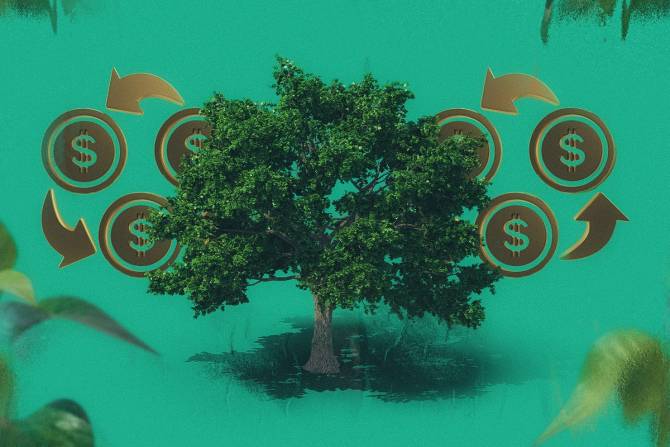
Tax equity investing is a way to reap tax benefits while collecting a tax write-off. It’s garnered the attention of corporate types under ESG pressure over the last year, Mike Bernier, partner of credits and incentives at EY, told CFO Brew. And experts tell CFO Brew that after the introduction of the Inflation Reduction Act and recent tax legislation, tax incentives for renewable (or green) projects have blossomed (pun very much intended).
“Over the last 12 months, [we] have seen a significant uptick in corporate interest in tax equity,” Bernier said. “If we go back prior to that, almost all of the tax equity players were what we call financial service companies: banks, insurance companies, investment banks, or your really big-name tech companies.”
Deals, deals, deals: One reason that green tax incentives are attracting the attention of financiers is that they can lower costs in a tight macroeconomic environment. As ever, taxes are top of mind, Gary Blitz, global co-CEO of Aon M&A Transactions Solutions told CFO Brew, and there’s a real desire to add certainty in an extremely uncertain environment. But green tax incentives can be a win-win, both for the investor and the company receiving the investment.
“Just think of a developer building a solar farm,” Blitz explained. “They need money to build it, and they’re able to go to financial institutions, or a lot of tech companies [that] do this and say, ‘If you invest [in us], you’re gonna get this tax credit.’” Continue reading here.—KT
|
|
TOGETHER WITH ORACLE NETSUITE
|
|
Needpix
“As Airbnb’s CFO, Dave Stephenson’s job boils down to making sure the company gets a good return on its investments—the biggest of which, he told HR Brew, is its people. Put that way, he doesn’t think it at all strange that as the head of finance, he’s also tasked with managing employee experience,” writes HR Brew’s Susanna Vogel.
Stephenson has had to make some tough calls: In 2020, for example, he led a company-wide restructuring, including layoffs of 25% of the workforce as the pandemic disrupted travel.
Since then, however, he’s helped guide Airbnb into the future, rolling out its “live and work anywhere” program last spring, which drove 800,000 applicants to the career page within the first week and has been adopted by 11% of its US workforce.
Stephenson said the company found employees did want to get together in person, just not five days a week.
“Some other companies are feeling like you should get in the office five days a week, or even three days a week,” he told HR Brew. “But I think that [gathering] randomly versus intentionally won’t get the same benefit.”
Read the full story here on HR Brew.—SV
|
|
TOGETHER WITH IMA® (INSTITUTE OF MANAGEMENT ACCOUNTANTS)
|
|
You are more than your spreadsheets. Are routine accounting tasks holding you back? Earn your CMA® (Certified Management Accountant) certification and get the boost you need to leave the spreadsheets behind. By mastering the 12 most critical practice areas of management accounting, you can hone your decision-making skills and step up to manage the bigger picture. Take control of your career.
|
|
Coworking is a weekly segment where we talk to CFOs and other leaders in the finance space about their experiences, their companies, and the larger economy. To be considered, answer a few quick questions for us here and we’ll be in touch if we want to feature you in the newsletter.
Rich Veldran is CFO of GoTo, formerly LogMeIn, a SaaS company that provides cloud-based, remote-work tools.
This interview has been lightly edited for length and clarity.
Give us an idea of what your company is doing right now, and things that you’re expecting or looking for, in terms of the larger economy.
As with most companies, you want to be flexible, and want to be able to just thrive in any environment. The goal is to really stick to your strategy, create value, and—regardless of the weather—be able to work through that. So as we plan through things, we look at different scenarios. We don’t want to be in a situation where you’re reactionary—where something happens and then you have to react and do something extreme, and you see companies do this all the time. You see them hire at an accelerated pace, and then all of a sudden, turn around and do a layoff. We want to avoid this kind of whipsaw behavior.
So we’ve asked what we’ve done, we’ve sat with our teams, and we’ve said, ‘Look, you know, we’re going to be transparent about what we see. We think that there’s some, some clouds on the horizon. But we’re gonna, as a team, work through this together. So we’d like you all to think about ways to do things more efficiently.’ So you’re not doing something to the team, you’re working with the team to handle any situation. That’s what we’re trying to do, so we’re very transparent.
And how do you define transparency, in terms of keeping employees up to speed?
It literally starts with just basic communication. Continue reading here.—KL
|
|
Francis Scialabba
Stat: $11 billion. That’s how much Meta CEO Mark Zuckerberg saw wiped off his net worth, following a Q3 earnings report that disappointed Wall Street and sent the company’s stock tumbling. (Bloomberg)
Quote: “Twitter obviously cannot become a free-for-all hellscape, where anything can be said with no consequences!”—Elon Musk, in a note to advertisers ahead of his acquisition of the social media platform, which closed Thursday. (@elonmusk)
Read: An analysis of just what Elon Musk is getting in his Twitter purchase: “...hopelessly addicted politicians, reporters, celebrities, and other people who should know better but keep posting anyway.” (The Verge)
In a snAP: AP is the most time-consuming function in finance. Wanna say farewell to this clunky process? Join Tipalti’s webinar to see how their end-to-end AP solution can upgrade your workflow. Register here.*
*This is sponsored advertising content.
|
|
-
Ned Segal, former Twitter CFO, was among the top executives fired after Elon Musk acquired the company; also let go were CEO Parag Agrawal and legal and policy exec Vijaya Gadde, who is widely credited with banning former President Trump from the platform in 2021.
-
Meta, Facebook’s parent company, was fined $24.6 million for violating Washington state’s campaign finance-disclosure law.
-
ExxonMobil reported a Q3 profit of ~$20 billion, due in large part to higher energy costs.
-
Gary Gensler, chair of the SEC, defended a new clawback rule that lets the agency recover executive bonuses that were based on erroneous financial statements.
|
|
Catch up on top CFO Brew stories from the recent past:
|
|
|