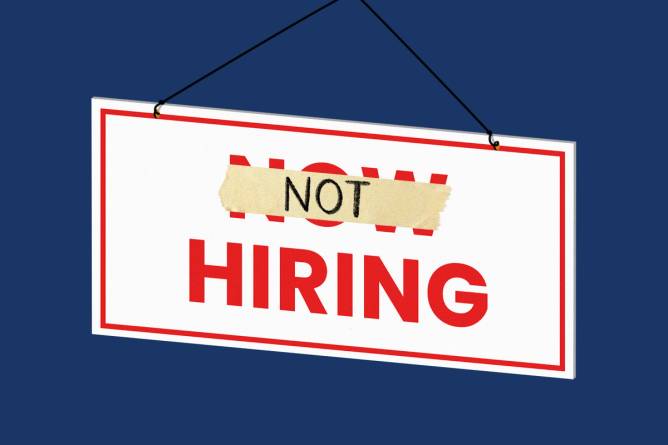
CONSUMERS Americans are feeling anxious about their ability to find new jobs. (And really, can you blame them?) Data from the New York Fed’s August Survey of Consumer Expectations shows that US consumers felt less confidence about their ability to find a job than at any point in the past 12 years. The survey, which polls around 1,300 heads of households on a monthly basis, found that respondents gave themselves only a 44.9% chance, on average, of landing a new job within three months should they lose one. That’s the lowest percentage since the Consumer Expectations Survey started asking about job searches in June 2013. The drop, the New York Fed wrote in a press release, “was broad-based across age, education, and income groups,” but was largest among respondents with a high-school education or less. Consumers also believed gas and food prices are on the rise this year. In December 2024, they predicted that gas prices would increase by 2% in the next 12 months. In both July and August of this year, they estimated gas prices would jump by 3.9%. Respondents estimated food price inflation of 4% in December 2024. For the past four months, they’ve forecast it at 5.5%. For more on consumer pessimism, click here.—CV | | |
|
|
Presented By Hyland You’ve got a lot of data—documents, chats, emails, images. The only problem is that organizations struggle to derive insights from the unstructured data they possess. That’s a huge blind spot and an even bigger missed opportunity. A commissioned study conducted by Forrester Consulting on behalf of Hyland explores how leaders are (or aren’t) tapping into this data. Here’s what they found: - Companies that have cracked unstructured data are already pulling ahead and shaping the future of innovation.
- 60%–80% of enterprise data is unstructured, and most organizations are still developing their ability to use this information.
- Nearly two-thirds of leaders are trying to modernize with AI, but content chaos is holding them back.
Ready to remove your data blind spot? Read the full study and make your data do some actual work. |
|
TALENT MANAGEMENT No one likes it when a teacher pulls out a red pen. Revisions are rarely fun. And with recent revisions to jobs numbers, we have a feeling the Bureau of Labor Statistics isn’t a fan of the red pen either. The US economy added jobs at a much slower clip than initially reported in 2024 and early 2025, the Labor Department’s Bureau of Labor Statistics said Tuesday, fueling concerns that the once seemingly sturdy job market has harbored deeper cracks than we previously realized. Annual revisions to payroll data demonstrated a 911,000 drop from previous estimates. That’s a decrease of over 50% from the 1.79 million total jobs the BLS previously reported. The leisure and hospitality sector was especially hard-hit by the revisions, subtracting 176,000 jobs from initial estimates. Professional and business services, as well as retail, were also revised down significantly. Ultimately, most sectors, with the exception of transportation, warehousing, and utilities, were downwardly revised. The corrections arrive as part of the BLS’s annual benchmark review of jobs numbers. The BLS historically updates the figures using more comprehensive data from state unemployment tax filings, which take longer than the business surveys it initially uses for jobs numbers. How many jobs are there, really?—NP | | |
|
|
CFOS Most people barely notice the power lines that stretch above them. But for some, it’s their job to observe, plan, and build the infrastructure connecting the electrical grid. And as the country moves to electrify everything from cars to bikes, that job is only getting more important. Bonnie Castle is the CFO of SBS, a design software platform for the utility industry. The company’s products help engineers design the power lines that connect to electrical substations. The platform enables a project developer to make plans for running lines through high wildfire risk areas, lays out when power lines can run underground vs. overhead, plus many more tiny nuances underlying the power grid that most people never think about. Castle gave CFO Brew a rundown of her job and offered advice for CFOs. This interview has been edited for clarity and length. What’s your playbook for handling this time of uncertainty and possible recession? We’re in an interesting space where we cater to utility companies. Whenever I think about what’s going on in the economy, the potential risk of a recession, or when Trump talks about tariffs, it actually puts us at a position of strength. That’s driven by the fact that really what’s going on is he’s encouraging everyone to invest in the US. And companies are doing that. You’re seeing very large companies like Google and Nvidia putting significant investment in the US by building data centers, and that then drives a huge demand for power generation. And so the utility businesses are growing like crazy. Keep reading here.—JK | | |
|
|
Together With RightRev Modern businesses monetize everything. Legacy accounting systems break under constant pricing changes, but your revenue doesn’t have to. RightRev can deliver accurate, compliant, forecast-ready revenue recognition automation so you can monetize AI credits, usage tiers, hardware + software, bundled services, and more with confidence. Demo here. |
|
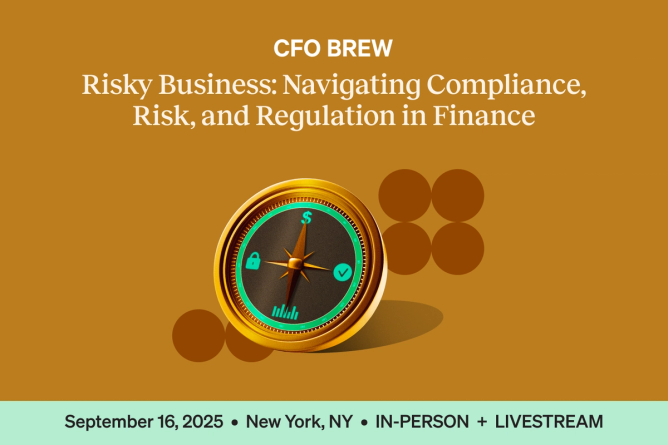
EVENTS From Affirm and Bayer Crop Science to Pagaya, Navan, Resilience, and more, top companies will unpack how CFOs are balancing growth with compliance, tackling data privacy, and navigating regulatory change. Join CFO Brew in New York—or virtually—on Sept. 16 for a half-day event shaping tomorrow’s finance playbook. Register here. |
|
|
MARKET FORCES Today’s top finance reads. Stat: 9,000. That’s how many employees drugmaker Novo Nordisk is shedding as it falls behind in the weight loss drug market. The Ozempic maker is losing market share to competitors and look-alike products.  (Wall Street Journal) (Wall Street Journal) Quote: “When you think from first principles about what generative AI can do, and what jobs it can replace, it’s the kind of things that young college grads have done. They read and synthesize information and data. They produce reports and presentations.”—Harvard economist David Deming on the impact AI is having on entry level jobs in white-collar firms  (The Atlantic) (The Atlantic) Read: Finding practical use cases for AI in accounting and finance. (Financial Management) |
|
|
JOBS | Skip the noise and cut to the jobs that matter. CollabWORK curates openings from top employers and shares them directly in trusted spaces like CFO Brew—click here to see the full list for readers like you. |
|
|
SHARE THE BREW Share CFO Brew with your coworkers, acquire free Brew swag, and then make new friends as a result of your fresh Brew swag. We’re saying we’ll give you free stuff and more friends if you share a link. One link. 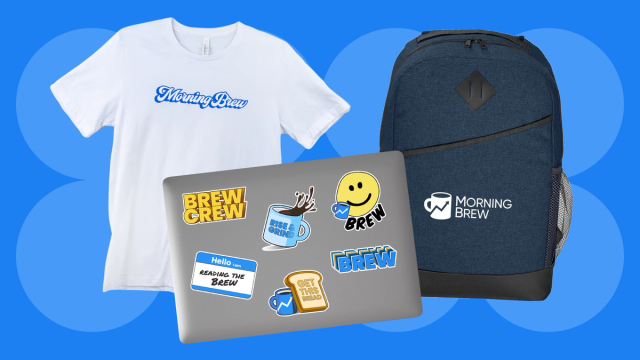 Your referral count: 5 Click to ShareOr copy & paste your referral link to others:
cfobrew.com/r/?kid=9ec4d467 |
|
|
|
ADVERTISE // CAREERS // SHOP // FAQ
Update your email preferences or unsubscribe .
View our privacy policy .
Copyright © 2025 Morning Brew Inc. All rights reserved.
22 W 19th St, 4th Floor, New York, NY 10011 |
|



 🪧
🪧