|
Hello, and happy Tuesday. There is life-threatening weather all over the country this week. Please make sure you, and your people, are staying safe. 🦺
In this issue:
 Heavy lifting Heavy lifting
 Say what? Say what?
 Trust issues Trust issues
—Drew Adamek, Courtney Vien, Graison Dangor, Kristen Parisi
|
|
Yauhen Akulich/Getty Images
|
Be prepared for a lot of corny puns from your favorite accounting publications: FASB has voted to implement an accounting standard dealing with the disaggregation of income statement expenses, or DISE.
Jokes aside, the new standard may pose quite the burden on public companies. It will require them to provide additional disclosures on a variety of items, including employee compensation, inventory purchases, amortization of intangible assets, and property and equipment depreciation, the Wall Street Journal reported.
Companies will need to disclose this information for each relevant expense item line in the footnotes of both their annual and quarterly income statements, starting in 2027 and 2028, respectively. They’ll also need to include a description of how they define selling expenses on an annual basis.
The new standard is intended to give investors more granular insight into companies’ sales and selling, general, and administrative (SG&A) expenses, something investors have requested, the FASB said.
But collating the required information will be a “significant lift” for companies, FASB chair Rich Jones acknowledged in March 2023, when the new standard was first proposed. To comply with it, many companies may incur one-time costs as they make changes to their ERP systems and potentially hire staff. Some large companies, including Apple, Starbucks, and IBM, have requested changes to the standard, calling it burdensome.
Click here for more on what FASB’s new rules might mean for you.—CV
|
|
PRESENTED BY ORACLE NETSUITE
|
|
As the saying goes, history repeats itself. But understanding history—especially the history of finance—helps leaders navigate the future. From the days of pen and paper to today’s AI, no job function has transformed over and over again quite like finance.
Oracle NetSuite’s The Modern Finance Function e-book explores the evolution of finance and how leaders can use its history to inform strategy today. You’ll find valuable insights from senior finance leader Anders Liu-Lindberg and other industry experts.
Study up on:
- finance’s journey from analog to digital processes
- achievements in the industry
- future trends and challenges to look out for
- AI’s evolving role in finance
Get your copy here.
|
|
Dny59/Getty Images
|
A year and a half after the launch of ChatGPT sparked conversations about how generative AI might change finance and accounting, the technology is still all over the place, in both senses of the phrase: (1) Everyone is talking about it, and (2) it’s unclear how useful it’s actually been.
To get the pulse on the GenAI discourse, CFO Brew checked in with finance leaders who attended the June CFO Leadership Council conference, where the topic was omnipresent.
Ready when you are. “Like most finance departments, we’ve started exploring GenAI tools that can potentially improve process efficiency or provide insights to help us create value,” Keith Ma, VP of finance at the pasta maker Banza, told CFO Brew in an email. “What we’ve found is that some GenAI tools being touted by vendors are not yet fully developed and in some cases are utilizing large amounts of manual human intervention in place of GenAI as the tool is built out. I’m excited for the future of GenAI, but for now, we need to be prepared to meaningfully partner with vendors in the development of those tools.”
Safety first. “I am very hesitant to use AI because of the confidential nature of our financial information,” Kelley Milligan Kline, CFO of research firm D3 Systems, told CFO Brew. “Using the various platforms to perhaps budget or project, but not knowing where that data is going, gives me great pause.” Before putting an AI tool to work with their systems, she said, “we would test it. And we would make sure that we’d scrutinize whatever type of agreement [is] required to see how the data will be utilized and protected moving forward.”
For more on how CFOs are approaching AI, click here.—GD
|
|
Emily Parsons
|
Many workers may soon trust AI to independently do some tasks for them, but they still want human oversight and touchpoints for certain functions, according to new data from Salesforce.
Building trust. The majority (77%) of respondents said they’ll eventually trust autonomous AI to make work easier, according to a spring Salesforce survey released on June 26. However, just 10% of the 6,000 knowledge workers surveyed in nine countries said they currently “trust AI to operate autonomously today.”
There are notable differences in who has confidence in the emerging technology. More than one-half (51%) of leaders who responded to the survey said they rely on AI to do their work, versus just 40% of the employees who responded. Respondents who understand how AI is used in their workplace are five times more likely to trust AI to operate autonomously within the next two years. But 54% of workers said they don’t know how AI is being used or regulated at their company.
Workers are more likely to trust AI when they know humans are still involved in the process, Paula Goldman, EVP and chief ethical and humane use officer at Salesforce, said during a press briefing about the findings. “We know that a human touch builds trust in AI,” she said. “The way that we design human/AI interaction has to evolve to keep pace with how quickly AI itself is evolving.”
Click here to continue reading HR Brew’s story.—KP
|
|
|
Discover Miss Excel’s secret hacks to unleashing the full power of Microsoft Excel in this free Excel class on optimizing your spreadsheets with lookup functions and shortcuts. The best news: If you can’t attend live, you’ll also get access to a 48-hour replay when you sign up. Register today for this FREE live workshop and save hours each week.
|
|
Francis Scialabba
Today’s top finance reads.
Stat: $487.2 million. That’s how much Boeing will pay in fines after the company agreed to plead guilty to conspiracy to defraud the government. The federal government says that Boeing lied about safety issues with the 737s involved in fatal crashes that killed 346 people. Boeing also agreed to spend “at least $455 million to strengthen compliance and safety programs,” according to federal prosecutors. (the Washington Post)
Quote: “Consumers’ automatic reaction is, ‘This sounds like yet another unfair thing firms are going to do to try and cheat us.’ The presumption is this is just another attempt to screw them over.”—Jean-Pierre Dubé, University of Chicago Booth School of Business marketing professor on consumer anger over perceived price gouging and shrinkflation among retailers.  (CNBC) (CNBC)
Listen: Who are the remote work winners and losers? (The Atlantic)
History, modern finance, + you: From pen and paper to AI, no function has evolved as much as finance. Learn how the industry’s history can inform today’s decision-makers in Oracle NetSuite’s e-book. Read about finance’s journey.* *A message from our sponsor.
|
|
|
Share CFO Brew with your coworkers, acquire free Brew swag, and then make new friends as a result of your fresh Brew swag.
We’re saying we’ll give you free stuff and more friends if you share a link. One link.
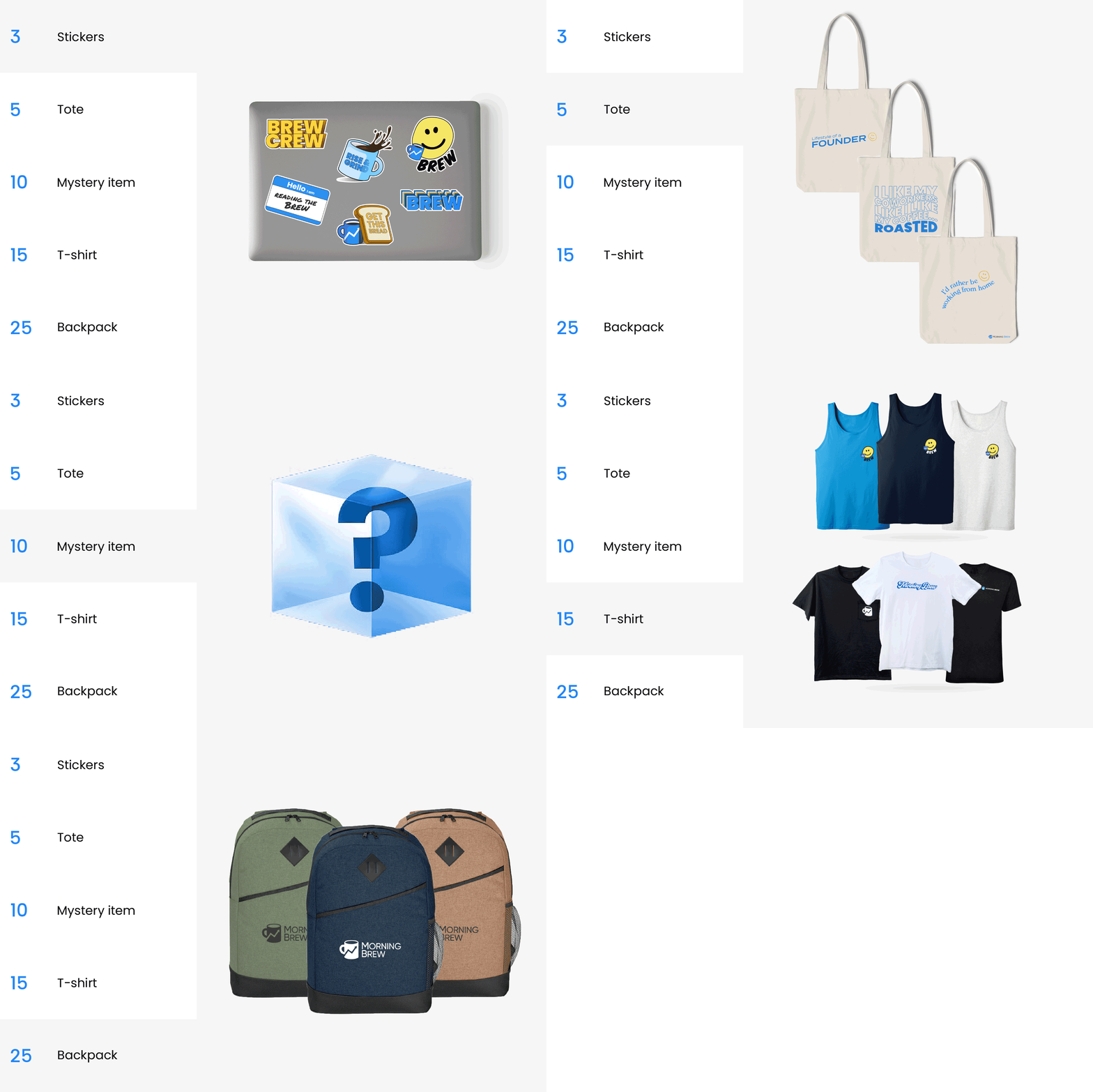
Your referral count: 2
Click to ShareOr copy & paste your referral link to others:
cfobrew.com/r/?kid=9ec4d467
|
|
ADVERTISE
//
CAREERS
//
SHOP
//
FAQ
Update your email preferences or unsubscribe
.
View our privacy policy
.
Copyright ©
2024
Morning Brew. All rights reserved.
22 W 19th St, 4th Floor, New York, NY 10011
|
|